Hospitality staffing still ran on agencies, group chats and spreadsheets. FlairMakers set out to replace all three with a marketplace both sides could actually trust.
Product Designer · Discovery, Strategy, UX/UI, Design System · B2B web, iOS, Android · 2025
FlairMakers
In brief
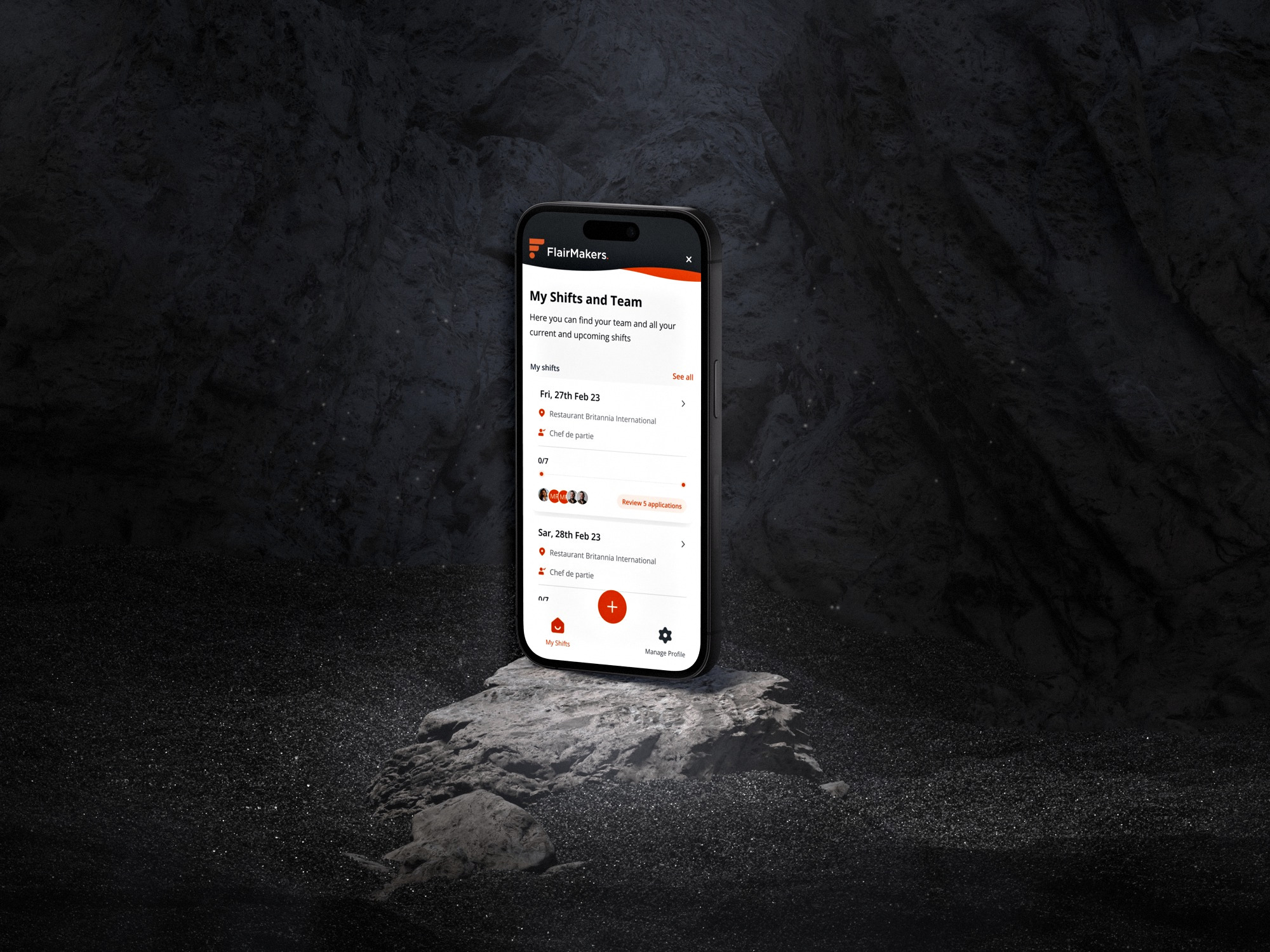
Two connected experiences, built around a single object: the shift. Businesses publish and review on the web; talent runs everything from the app. I worked directly alongside the founder, from discovery through launch and past it.
- Worked as
- Product Designer — Discovery, Strategy, UX/UI, Design System
- Designed with
- Founder-led, working directly with the CEO
- Built for
- B2B web · iOS · Android
- Started from
- 2025
A market built on trust, running on none
Two groups needed each other and had no good way to meet. The hard part was never the interfaces. It was designing trust between two sides who had never had a reason to rely on each other.
Venues needed to fill shifts quickly without leaning on agencies or a last-minute scramble through Facebook groups. Hospitality professionals needed reliable work, a reputation that followed them from venue to venue, and to be paid without chasing anyone.
Businesses needed
- Fill shifts fast, without agencies.
- See real experience and ratings before hiring.
- Track who actually showed up.
- Run staffing from one place.
Talent needed
- Flexible work nearby.
- A profile and reputation that travels.
- Same-day payment.
- An easy way to check into a shift.
I worked directly alongside the founder throughout discovery, design and launch. The CEO had run hospitality operations at scale and understood workforce management from the inside. My job was to translate that operational knowledge into a product both sides would actually adopt.
Two products, one loop
Two connected experiences, built around a single object: the shift. Every review, rating and payment feeds the next one, so the marketplace grows more trustworthy the more it is used.
Businesses create and manage shifts on the web. Talent discovers and works them from the app. One decision shaped everything else: treat hospitality workers as professionals building a career, not temporary staff to be slotted in. That reframing changed the profile, the reviews, and the language throughout the product.
A profile worth carrying
A professional’s reputation is their most valuable asset, so onboarding was built to produce a strong one. Guided steps, document and certificate uploads, and pointed guidance (down to which profile photos to avoid) helped people present themselves well, and gave businesses something credible to trust before a shift ever started.
The shift, in full, before you commit
Every shift shows the pay, the net hours, the distance and the exact tasks up front. Nothing is buried, and talent can even open a negotiation on the wage. Transparency was a deliberate trust move: when people can see exactly what they are agreeing to, they show up, and they come back.
Trust, made mutual
Reviews run both ways. After a shift, businesses rate talent across specific qualities, professionalism, punctuality, adaptability, rather than a single blunt star. Talent build a reputation that travels with them. Payment, commission and tips are laid out plainly in the same place. The loop closes, and the next shift starts from a higher base of trust.
Staffing from one place
On the business side, everything lives in one view: open shifts, applicants, the team on the floor, attendance, ratings and the full payment breakdown. What used to be spread across agencies, messages and spreadsheets became a single place to run staffing.
“Thrilled at the prospect of connecting with talented freelancers in the hospitality industry. The concept aligns perfectly with our need for flexible professionals who can contribute to our unique offerings. The anticipation for this platform’s launch is high, and we look forward to exploring the diverse pool of freelancers it promises to bring, enriching our team and elevating our guest experiences.”
Discovery to launch, and past it
Designing for two very different users at once, in direct partnership with the founder, from the first research through the App Store and the first user interviews.
- Discovery
- Competitive and market research, feature prioritization, journey mapping, and the product strategy that set the direction for both sides.
- Design
- UX and UI for both products, information architecture, user flows, wireframes and interactive prototypes, iterated closely with engineering.
- Design system
- A single system shared across web and mobile: components, interaction patterns, typography and documentation, so two very different products still felt like one.
- Beyond handoff
- App Store launch, production testing and QA (quality assurance), and the first user interviews. I watched real people build their profiles and fed what I saw straight back into onboarding.
Three of those working artifacts, redrawn: the same loops, told the way the FlowX dependency diagrams are, as a system rather than a screenshot.
A decline doesn’t dead-end anything: the shift simply goes back to the pool, no different from before it was offered.
Reputation carries forward on both sides, so the next match starts from a higher base of trust than this one did.
The loop closes back into Getting matched: a completed review changes what the next posting, application and acceptance look like for that same pair of people.
A decline doesn’t block anything: the engagement simply ends at its original time, no different from if the extension had never been offered. Extending an engagement also meant putting the extra pay on hold before it was confirmed, a detail that took real back-and-forth with Stripe (the payment provider) to validate, not assume.
Punctuality and feedback are tracked independently, and neither blocks the other: a late start is still logged even if feedback waits, and feedback can still be left after the notification itself has closed.
See more detailsHide details
One of the original artifacts, unredrawn: an early exploration for in-app messaging, not yet built, mapping how a business partner or a talent would each start a new message or respond to one.
Launched on iOS, Android and web, and it kept growing.
Businesses started managing staffing on the platform; hospitality professionals built profiles and applied for shifts. I stayed on past handoff, through the App Store launch, production testing and QA, and the first user interviews, watching real people create their profiles and feeding what I learned straight back into onboarding.
Since then
The milestones below came after my direct involvement, but they trace the same vision forward:
- Grew into a broader hospitality Talent-as-a-Service platform.
- Partnered with UKHospitality.
- Partnered with Lobster Ink for hospitality learning.
- Expanded from staffing into training, compliance and career development.
- Won London Hospitality, Tourism & Events Start-Up of the Year 2026.
Two very different users, one founder, and a marketplace that lives on trust.
Designing for two very different users, in direct partnership with a founder, from discovery through launch and past it, sharpened how I build marketplace products.
Great marketplaces are not built around transactions. They are built around trust.
A photograph of mine, just below ↓